
The SuperDQP Weekly - December 29, 2025

The final game I want to cover for 2025’s Great Backlog Offensive quickly etched itself into my personal list of favorite all-time games, and for many, many good reasons. If you know me, and you know the game, you could probably easily guess why.
Let’s chat about Mother 3.
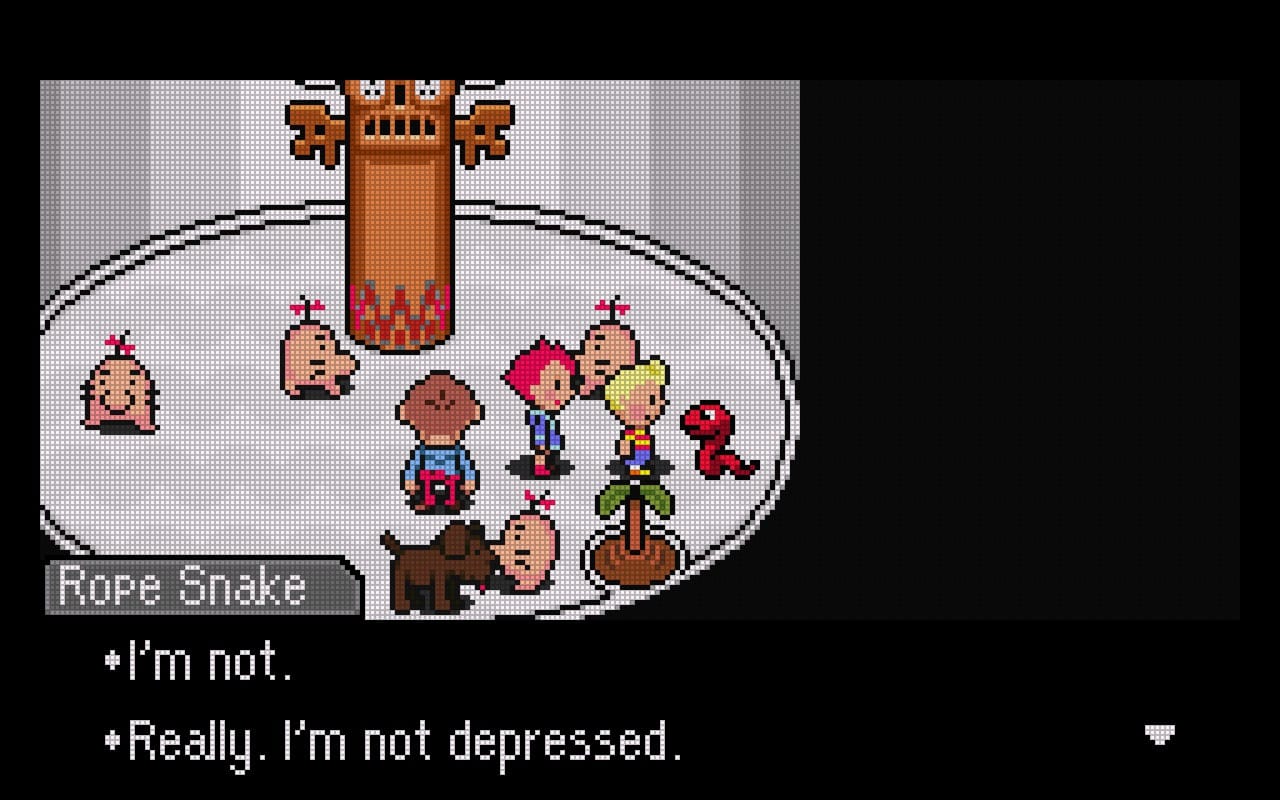
The greatest RPG that Nintendo of America apparently doesn’t like
This newsletter is a part of my Great Backlog Offensive miniseries. In 2015 and 2020, these were videos for my now-defunct YouTube channel meant to look at classic games from a modern lens. I am reviving it this year with five more old-to-old-ish games. Check out the first entry on DUSK, the second entry on Half-Life: Alyx, the third entry on Tales from the Borderlands, and the fourth entry on OMORI.
Mother 3 shook me to my core. I started it in an airport more or less by chance and spent the following month in, and I mean this as a compliment, severe emotional distress.
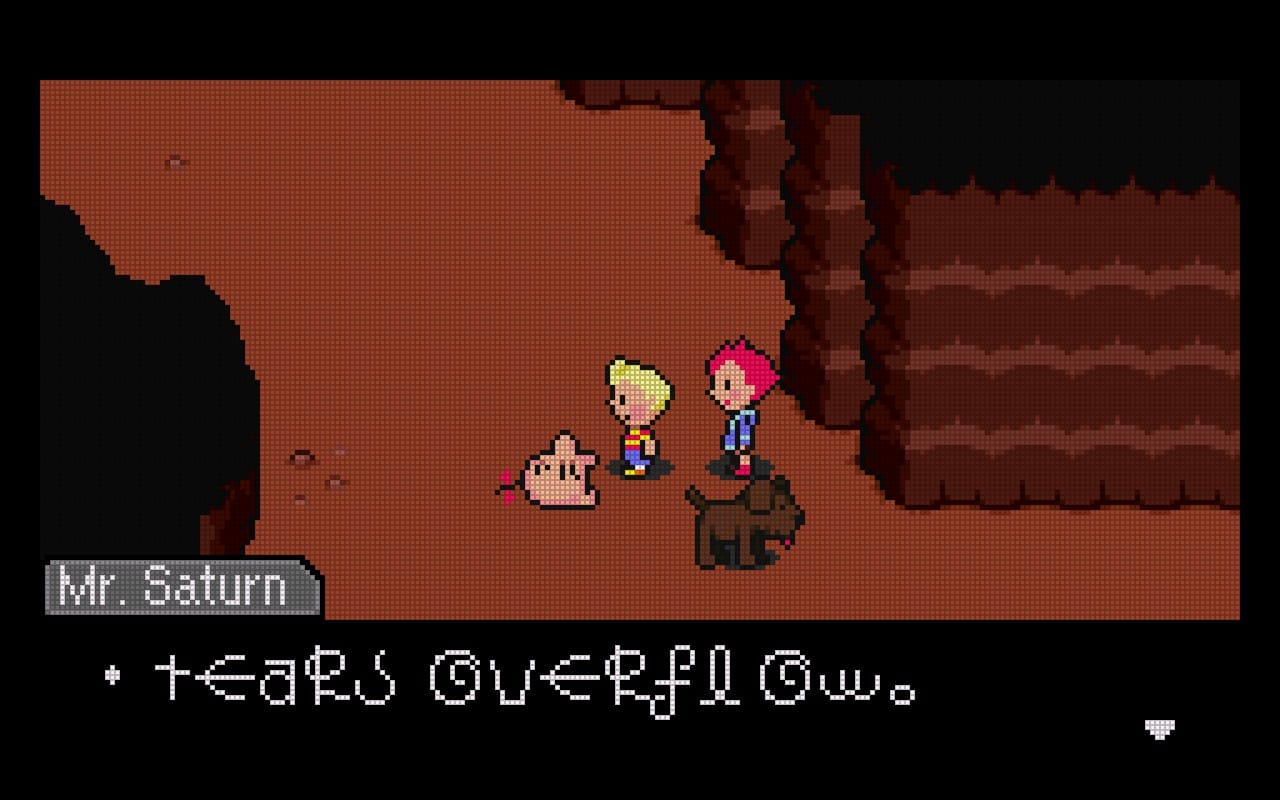
This actually caught one of my friends off guard. He couldn’t believe I hadn’t played it already. And having finished it, honestly, neither can I. It is, a couple poorly-aged tropes notwithstanding, the perfect game for me.
And it’s not like this is a particularly costly game to play. I’ll be candid: I played the unofficial Starman.net fan translation from 2008, which cost me $0, but is… legally dubious, to put it diplomatically. But the only two alternatives are, A) learn Japanese and import an expensive GBA cartridge, or B) no Mother 3 at all.
Mother 3 is infamous for its legal inaccessibility to non-Japanese audiences. Nintendo has even joked about it at E3 at fans’ expense, without actually having the courtesy to release the damn thing.
There are a lot of speculated reasons for why it’s never come to the United States, from its release too late into the Game Boy Advance’s life cycle – the Starman.net translation released four years after its successor, the DS, was out – to the unfortunately-named “Magypsy” characters being perceived as leaning into transphobic stereotypes, including a genuinely cringe-inducing interaction in a hot spring.
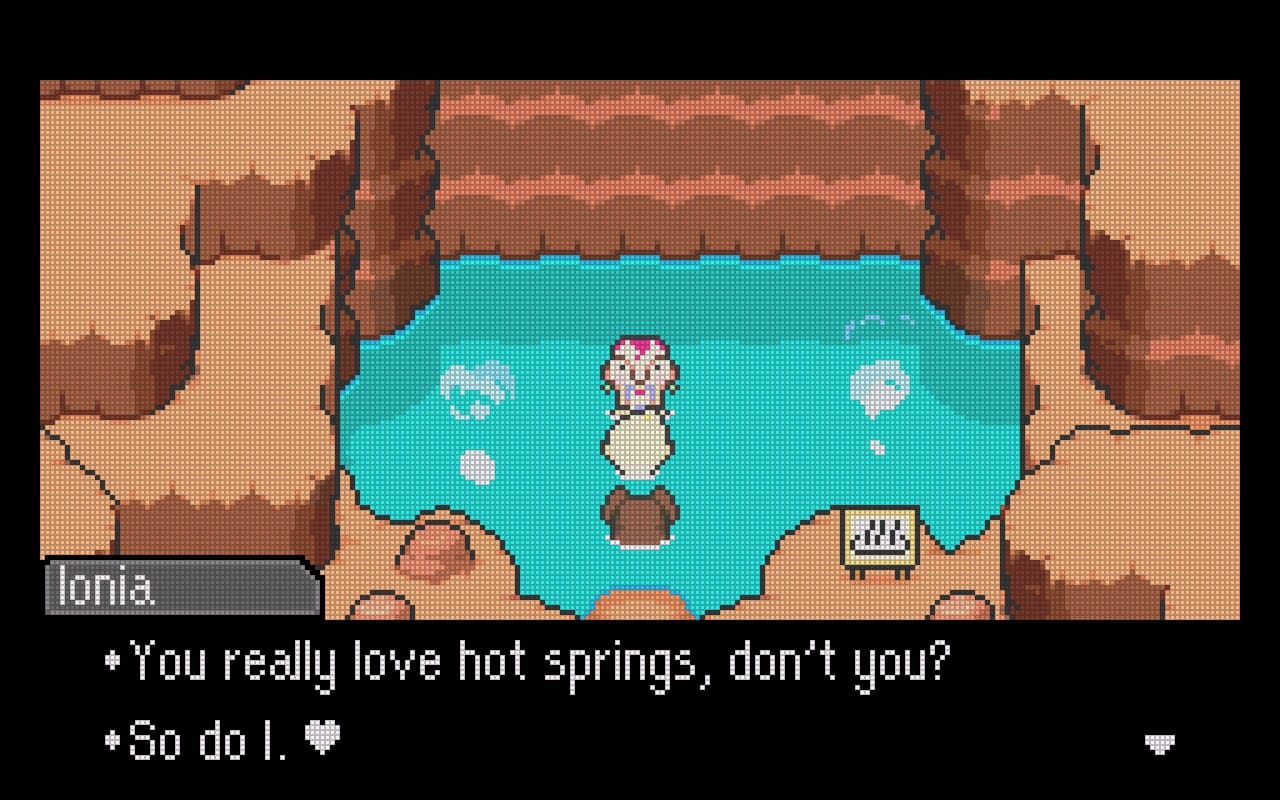
(For what it’s worth, I think writer and director Shigesato Itoi was well-meaning and included these characters for the sake of having positive interactions with them, and they are unambiguous forces for good in the context of the story, and I think their resemblance to modern drag queens, especially drag queens here in Anchorage, makes them more believably positive, but… woof, that hot spring scene is a lot and I can’t say a lot to justify it.)
But even the potential gender moral panic pales in comparison to what I personally think is the real reason Nintendo of America is so hesitant to pick this game up.
Mother 3 is one of the sharpest and most biting critiques of the United States of America I think I’ve ever seen in a video game. I’ve played Fallout: New Vegas and The Outer Worlds, Metal Gear Rising: Revengeance, Spec Ops: The Line, Deus Ex, BioShock: Infinite, and Wolfenstein II: The New Colossus, and I think Mother 3 damn near tops that list in terms of how much sheer spite it has towards the imperial project of the USA.
(New Vegas, Wolfenstein II, and Spec Ops all give it a real good run for its money, though, and this can be debated at a later point.)
All three Mother/Earthbound games take place in a pastiche of American suburbia, and though the first two have their darker sides, they lean quirky. I see them more as parodies of Dragon Quest than I do as effective satires of the United States and its culture; replacing the fantastical monsters of the latter with the stray dogs, hippies, and suburban cultists of the former. The fact that one of the epic RPG bosses in Earthbound is a monster literally made out of vomit is part of the joke.
Mother 3 is starkly different from this. It is plainly, immediately bleak in a way that the first two games don’t reach, and that bleakness paints its later depiction of western suburbia in a far more bitter hue.
(This is where I’m gonna start spoiling things, by the way, if you care.)
A common theme in the Mother games, as the title suggests, is the safety of home. In Earthbound, for example, no matter what happens, you can always call your mom to talk about life, and your dad is always ready to save your game or drop unconscionable amounts of money into your bank account. And if push comes to shove, you can always physically return home and have your mom make you your favorite food, which fully heals you. And this is always the case up until the final boss.
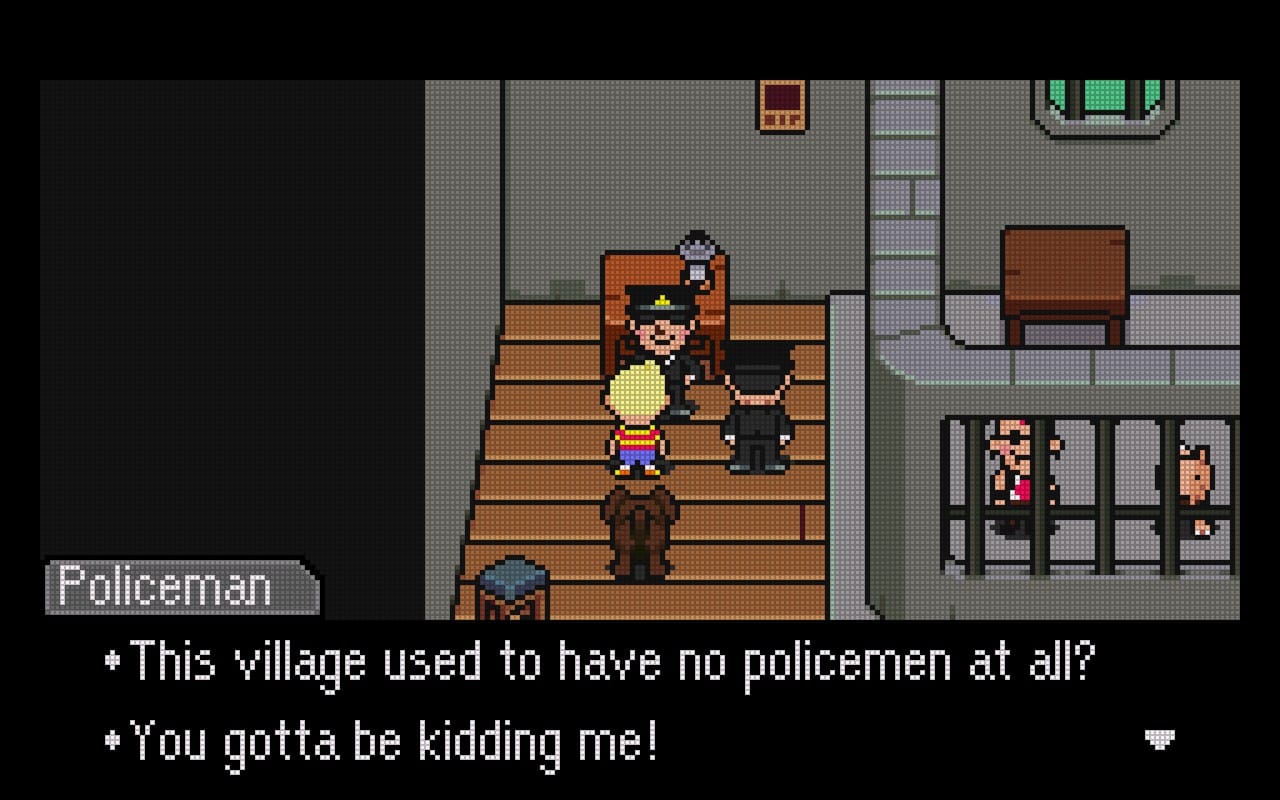
Not too long after Mother 3 starts, it violently rips all of this away from the player. The player character’s mother dies at the indirect hands of fascists. His father and brother turn bitter and cold, and before long, he’s off on his quest with only relative strangers to help him.
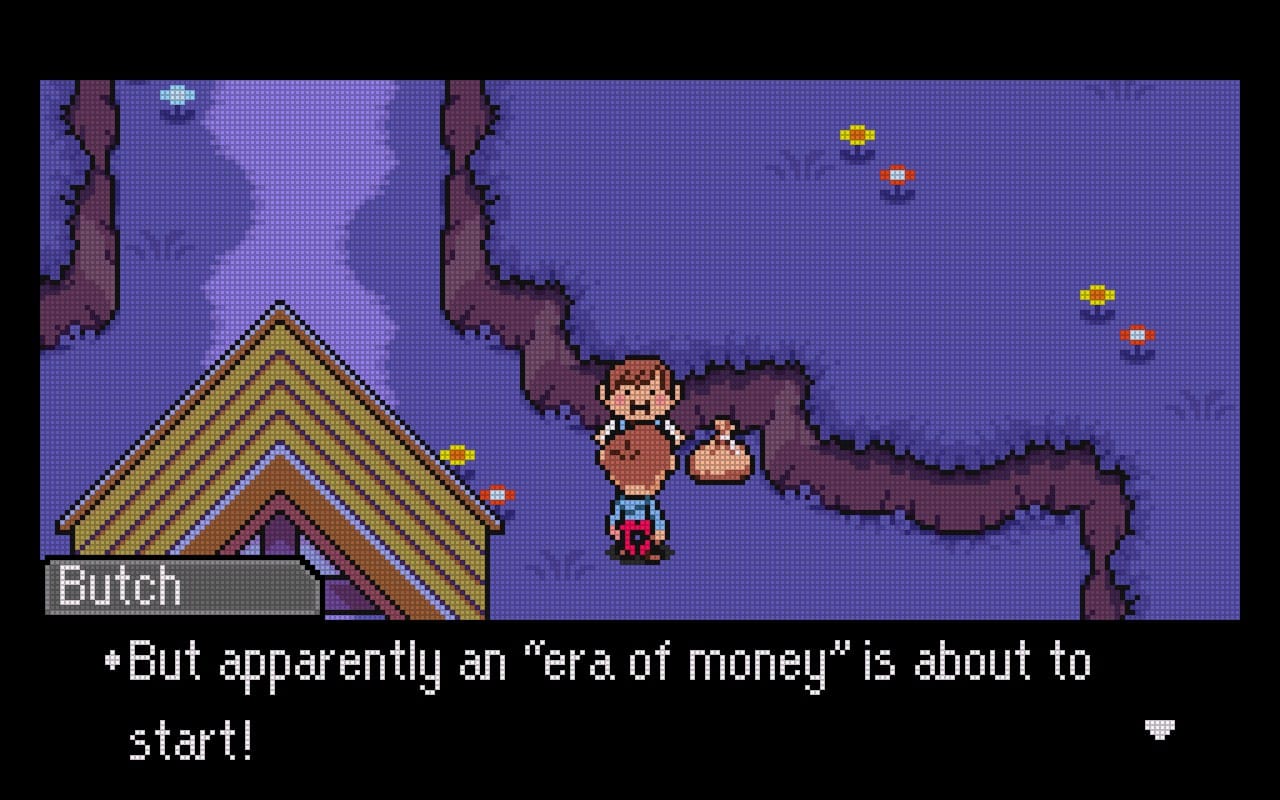
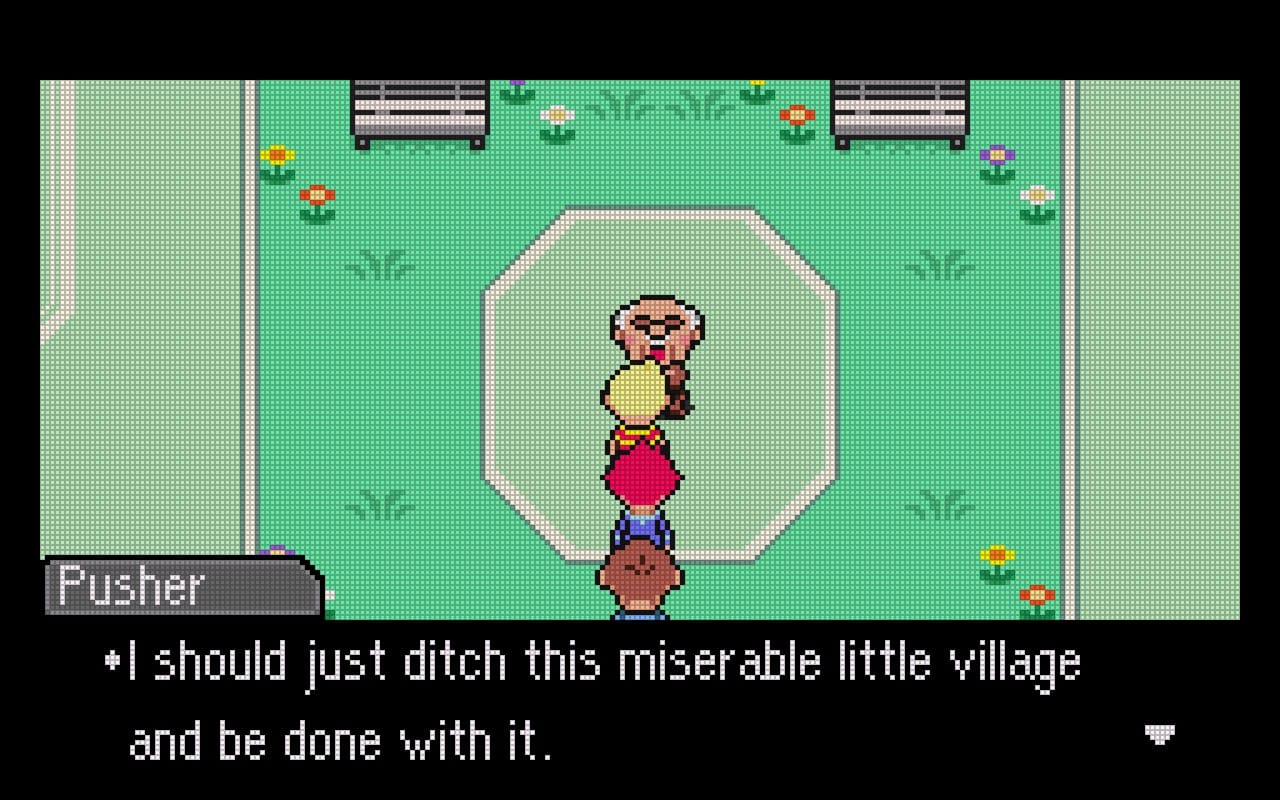
The player character’s hometown starts as this utopia reminiscent of John Lennon’s Imagine, where there’s no money and everyone has enough and the community is able to lend a hand when need be. The aforementioned fascists (they’re called Pigmen because subtlety is for chumps) also snatch this away, tempting the villagers with “happy boxes” (read: televisions) and commercialism, introducing all the trappings of Western life: money, cops, cars, a bustling military facility next door, and even the eventual promise of a railroad.
By the time the post-Chapter-2 timeskip rolls around, the Pigmen have fully gentrified the village to the point that the player character feels almost completely alienated. It looks almost identical to the player’s hometown in Earthbound, but this doesn’t feel like home anymore. It feels like home was forcefully taken away and replaced with something “better.”
Chapter 3 left me feeling devastated, like this horrible, America-shaped creature had bulldozed and brainwashed a kind-hearted community into a group of hungry customers.
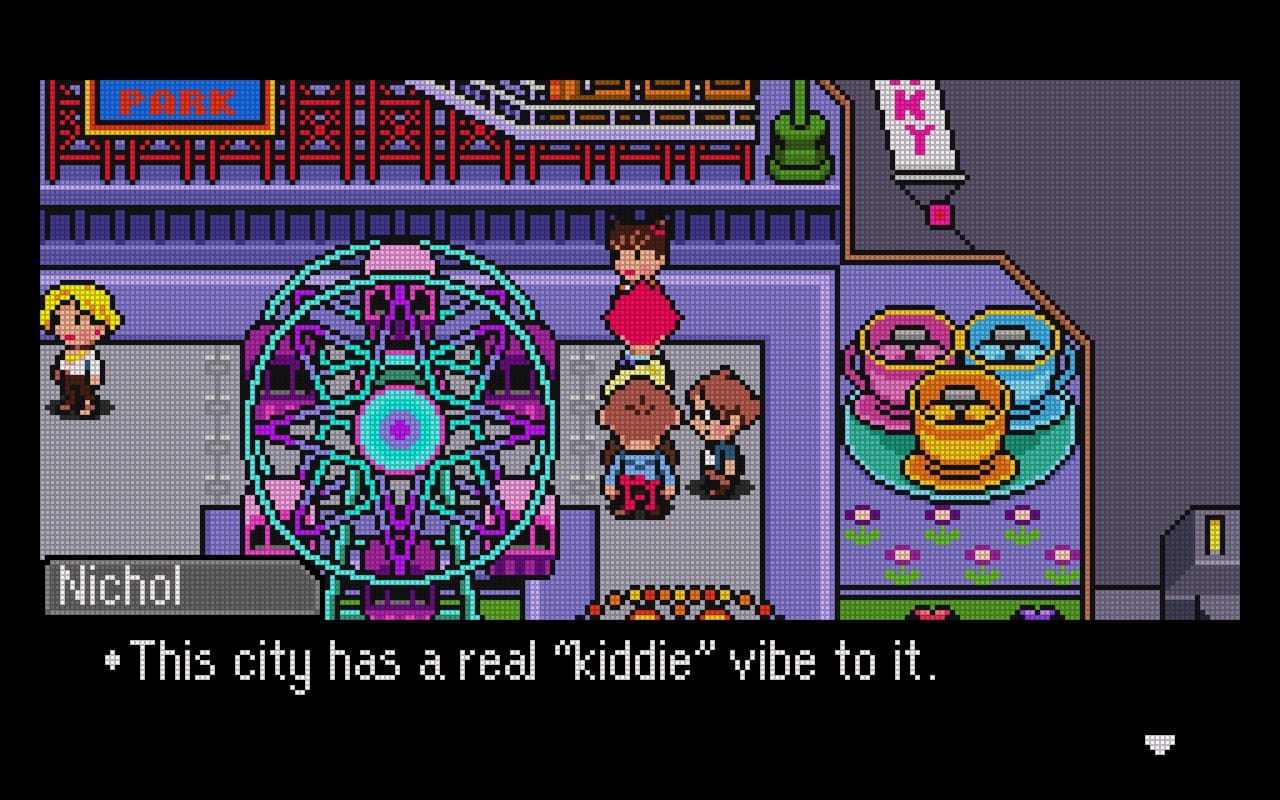
The game keeps going on like this. Eventually the people of this village are tempted away to a new, dazzling far away city, only for the veil to finally lift from their eyes when they realize that this “New Pork City” is cheap, shoddily built, and overwhelming in a way that would be kitschy if it weren’t so damning of the regime that built it.
New Pork City is a stage in Super Smash Bros. Brawl, for what it’s worth, and this newly-discovered political context makes the fact that it’s one of the worst stages in the Smash series incredibly funny.
Mother 3 is an RPG-length condemnation of American colonialism, capitalism, and imperialism. It reframes the warm suburbia of the previous games as a hostile invading force, paving over culture and enslaving if not outright killing its people with the allure of riches and property.
And I imagine that some poor soul at Nintendo of America finished this game in 2006, looked at the re-election of George W. Bush and the success of military propaganda in American movies and games of the era, and thought, “Oh no. We can’t release this now.”
And I also imagine that there are more poor souls at Nintendo of America right now, in 2025, who look at our current political situation, with rising fascist sentiment and institutional transphobia, thinking, “Oh no. We really can’t release this now.”
And a part of me understands that, even after NoA finally confirmed Vivian’s transness in the recent remake of Paper Mario: The Thousand-Year Door. I think that if a modern release or remake of Mother 3 were to hit the Switch and/or Switch 2, after the initial euphoria of the announcement, there would be a hellacious controversy surrounding not only the Magypsies, but the anti-capitalist, anti-fascist, and anti-imperialist messaging of the game. I’d even bet money on the sitting president crashing out about it on Truth Social.
Mother 3 is a politically radical and radioactive object, in a way that 99.999% of Nintendo’s work flatly isn’t. But while I think that’s the primary reason it won’t see an American release any time soon, I also think that’s a part of what makes it so special.
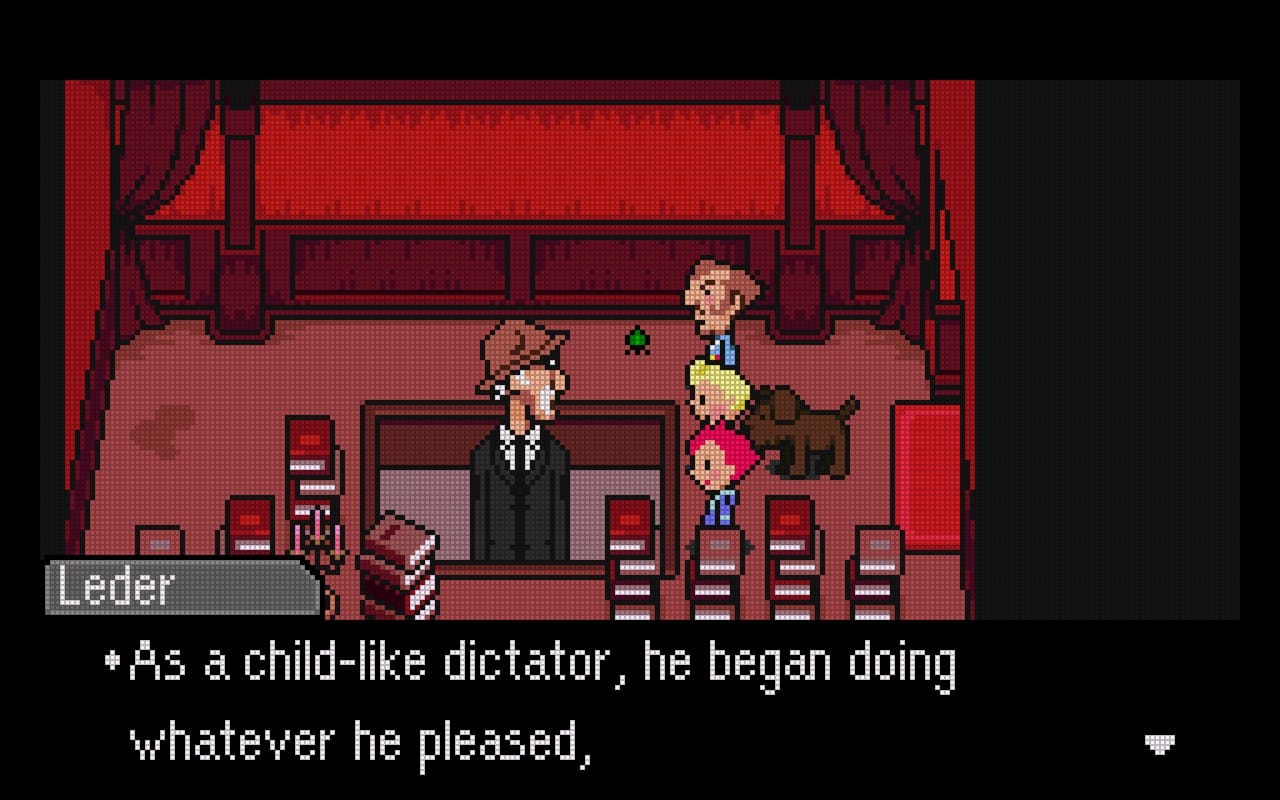
In spite of the darkness and cynicism of the writing, Mother 3 can be such a warm game. Characters understand how dire the circumstances are and genuinely want to see the player character through to their goal. They learn from their mistakes and grow, and by the end, when the fascist leader is imprisoned forever in a hell-sphere of perfect safety, the characters want to reassure you of their own relatively-freeform safety and their belief in you.
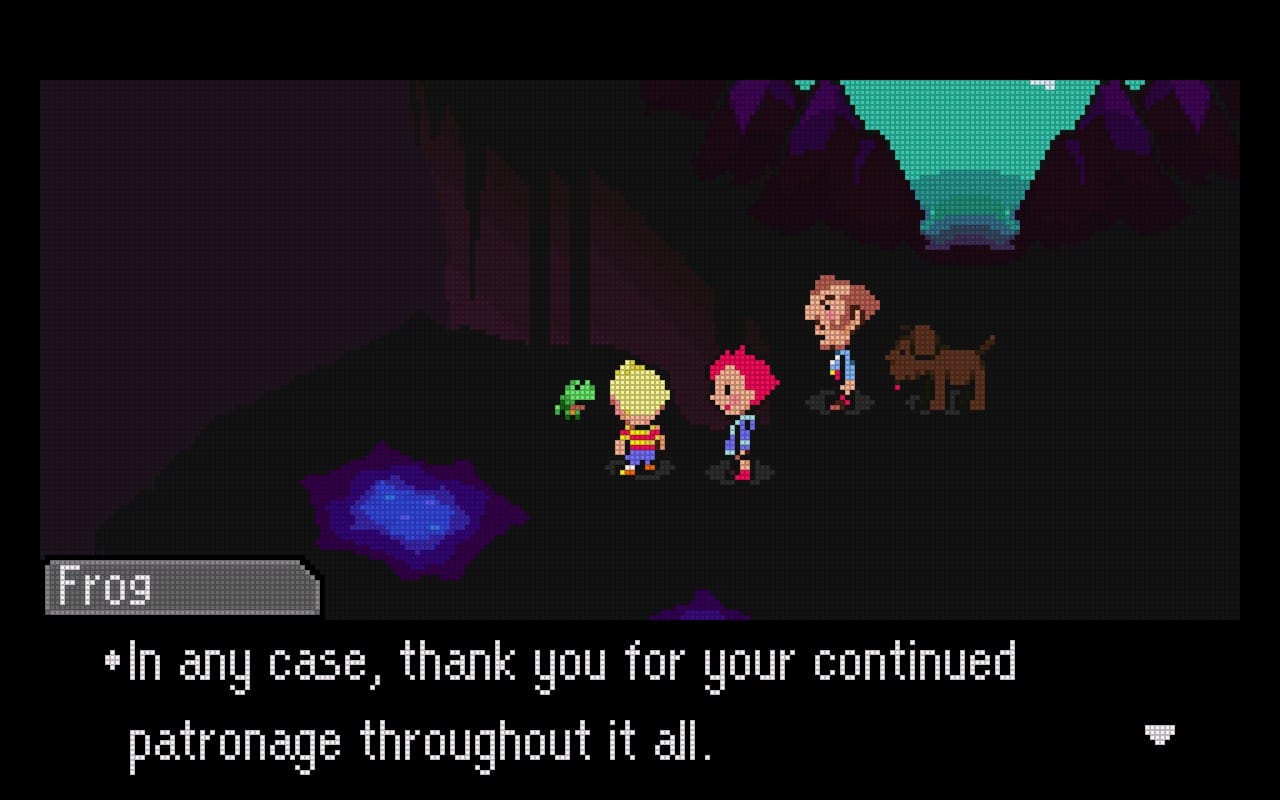
Because on top of being built on wholesome themes of home and family, the Mother trilogy has also always operated on the belief that everything will be okay in the long run, and that there are always people cheering you on. That’s the case when you’re fighting tough guys in the arcade in Earthbound, and it’s the case when murderous fascists try to kill you in Mother 3.
That’s an important thing to remember in 2025. I wish that Nintendo of America also recognizes that someday.
I’ll go ahead and plant my flag: I think Mother 3 is one of the best to ever do it. Put this game in classrooms, libraries, and museums the world over.
And Nintendo, I know you’re not reading this, but if you ever think about an American release, I think it’d be really cool to hand the entire trilogy over to Digital Eclipse for a Gold Master collection. I will devour any and all interviews and historical context such a release would give. I want to pay for this game. Let me.